

For most of the last decade, compliance in outsourcing meant a checklist: GDPR, HIPAA, PCI DSS, SOC 2; a set of certifications to verify, a box to check during vendor onboarding, and a clause buried in the master service agreement. That era is over.
In 2026, the compliance conversation at the executive level has undergone a fundamental shift. The acceleration of AI integration across outsourced operations has introduced a new and far more complex class of risk, one that is not captured by traditional audit frameworks, and one that boards, founders, and C-suite leaders can no longer afford to delegate entirely to their compliance teams.
The question is no longer simply whether your BPO partner is certified. The question is whether they are governed.
The Compliance Landscape Has Changed Permanently
Regulatory pressure is intensifying on multiple fronts simultaneously. The EU AI Act, NIST AI Risk Management Framework, ISO/IEC 42001:2023, and sector-specific mandates across financial services, healthcare, and telecommunications have elevated AI governance from an internal IT concern to a board-level strategic imperative.
Governance Intelligence’s 2026 GRC outlook puts it clearly:
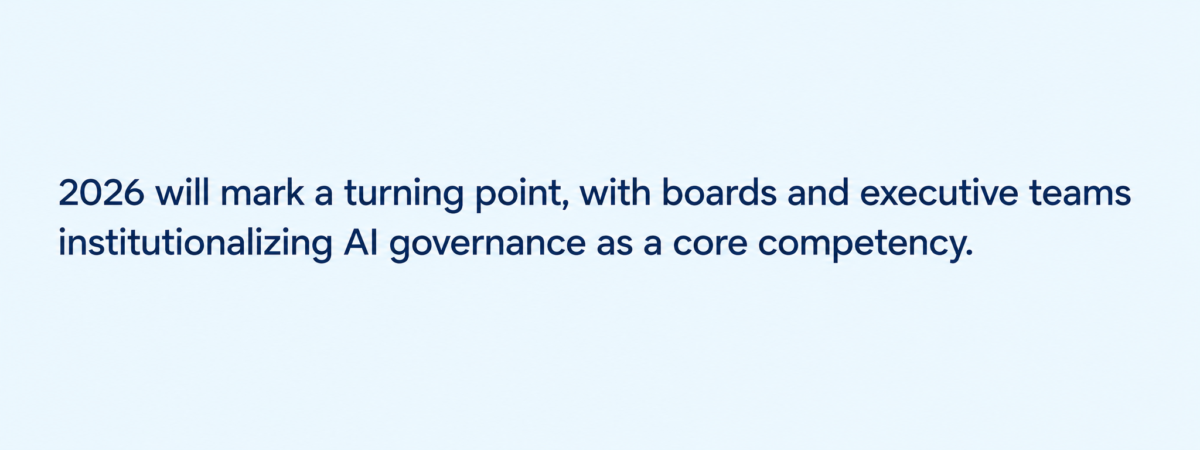
When AI is embedded in your outsourced operations (BPO), your partner’s AI governance posture becomes your compliance exposure. Data misuse, algorithmic bias, and uncontrolled model drift are active operational realities, meaning governance must be embedded through continuous learning, proactive oversight, and agile risk management to protect your organization.
Why Traditional Compliance Frameworks Are No Longer Sufficient
Traditional, human-centric compliance frameworks are fundamentally unequipped to govern autonomous AI systems, a reality punctuated by the SEC’s 2026 examination priorities shifting focus from cryptocurrency to AI risk and cybersecurity.
Across highly regulated sectors like finance and healthcare, auditors are now pressing for answers on algorithmic accountability, model drift, and documented AI decision-making; blind spots that legacy SOC 2 or HIPAA certifications fail to address.
For executive leaders, this shift means that if your current BPO partner lacks a structured AI governance framework to answer these questions, you are actively carrying undisclosed compliance risk on your balance sheet.
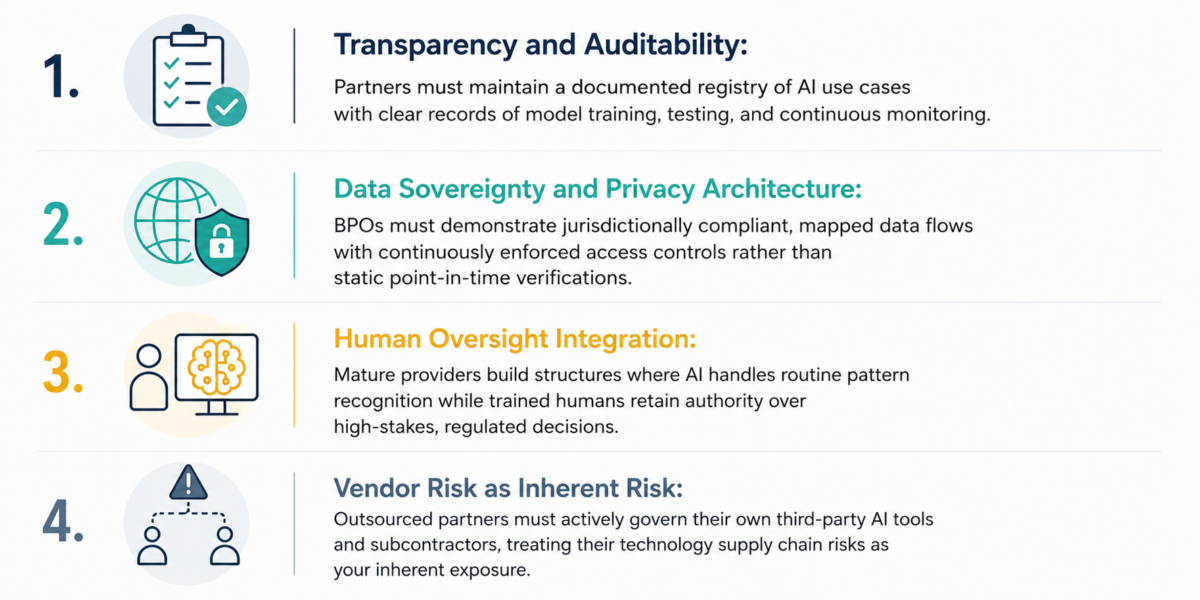
The Four Pillars of AI-Ready Compliance in BPO
Organizations that are navigating this transition successfully share a common approach. Rather than treating compliance as a static certification exercise, they evaluate their outsourcing partners across four active governance dimensions:
The Cost of Getting This Wrong
The consequences of misaligned AI governance in outsourced operations are not theoretical. They manifest in three increasingly costly ways.
Regulatory penalties for non-compliance with evolving AI and data privacy frameworks can be substantial, particularly in Canada, the EU, and regulated US sectors where enforcement activity is accelerating.
Reputational damage from a data breach or AI-driven service failure in a customer-facing outsourced function can erode brand equity that took years to build.
And perhaps most immediately impactful for growing organizations: the operational cost of unwinding a non-compliant BPO relationship mid-contract, including data migration, process repatriation, and replacement vendor onboarding, can be severe.
For founders and decision-makers evaluating outsourcing partnerships, compliance due diligence is no longer a procurement function. It is a strategic leadership responsibility.
What to Demand from Your Outsourcing Partner in 2026
The compliance conversation with a prospective or incumbent BPO partner should now include a set of questions that would have seemed premature five years ago:
- What AI governance framework does your organization operate under, and is it independently certified?
- How do you document and audit AI-assisted decisions in regulated processes?
- What is your incident response protocol when an AI system produces a non-compliant output?
- How do you manage model drift in production environments?
- What third-party AI tools are embedded in your delivery stack, and what contractual controls govern their use of our data?
The answers to these questions will reveal more about a provider’s compliance maturity than any certification alone.
The Strategic Imperative for Executive Leaders
The organizations that will define the next decade of operational excellence are those that outsource most intelligently. And in 2026, intelligence in outsourcing begins with governance.
For C-suite executives leaderships the mandate is clear: elevate the compliance conversation with your outsourcing partners from a vendor management function to a strategic leadership priority.
NCRi’s Commitment to Compliance-First Outsourcing
Compliance is the foundation of every engagement across our operations in multiple regions. As we integrate AI in operations, we maintain strict human oversight, documented use-case registries, and client-specific data governance aligned with global standards.
Our conviction is straightforward: you aren’t transferring your compliance obligation, you are gaining a partner who shares it completely. In an environment where regulatory risk accelerates daily, that partnership isn’t just a differentiator; it’s a prerequisite.
Contact NCRi Inc today to future-proof your operations.
0 comments on “How AI Governance Has Become a Critical Factor in Modern Outsourcing Decisions?”