

The global BPO market has eclipsed $400B, and the momentum behind near-shoring is undeniable. Currently,73% of enterprises citing time-zone alignment as their primary driver for moving operations to hubs like Colombia, Mexico, Poland, or Romania. On the surface, the logic is defensible: cultural proximity, talent depth, and operational synchronicity.
However, a strategic blind spot is emerging. When an entire industry makes the same geographic bet simultaneously, it creates a collective vulnerability. In the rush for proximity, many organizations are inadvertently trading one form of concentration risk for another.
The 2005 Playbook Remastered
The current shift mirrors the offshore surge of the early 2000s. At that time, the mandate was clear: scale rapidly in India and the Philippines to capture labor arbitrage. It was a brilliant strategy until it wasn’t.
None of those risks were unknowable. They were just unpriced because everyone was moving too fast to ask the uncomfortable question: what happens to our operations when this specific geography hits turbulence?
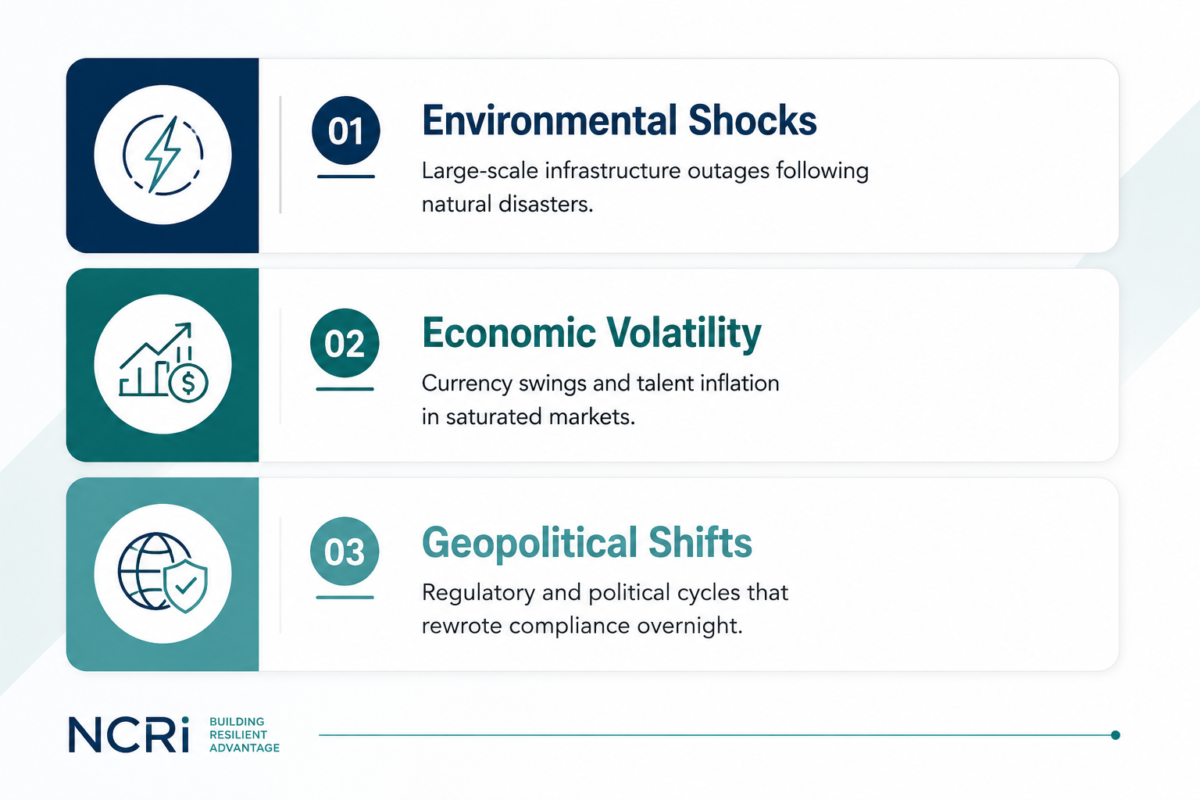
Enterprises eventually faced the “unpriced” risks of geographic concentration:
Image
- Environmental Shocks: Large-scale infrastructure outages following natural disasters.
- Economic Volatility: Currency swings and talent inflation in saturated markets.
- Geopolitical Shifts: Regulatory and political cycles that rewrote compliance overnight.
In 2026, the nearshore wave is following this identical pattern. Concentration risk is now the inevitable result of a follow-the-herd location strategy.
Assessing the Four Hidden Risks in Nearshore Contracts
While nearshoring offers immediate benefits, a lack of geographic diversity introduces four critical exposures:
- Geopolitical exposure: Latin American regulatory environments shift quickly. Eastern European proximity to active conflict zones is not theoretical. When a country’s political posture changes, your SLA doesn’t automatically adapt with it.
- Talent inflation: Nearshore hubs are being flooded by demand. When every enterprise targets the same talent pool simultaneously, wages rise, attrition spikes, and quality drops, the same arc Indian BPO markets went through between 2005 and 2012.
- Data sovereignty drift: GDPR, PIPEDA, and emerging AI Act obligations are highly geography-dependent. A nearshore hub that’s compliant today can sit outside your required data residency boundaries after a single regulatory update.
- Single-point continuity failure: If your entire outsourced operation runs through one geography, one internet backbone, or one labor market a strike, a natural disaster, or an infrastructure failure doesn’t slow you down. It stops you cold.
From Location Strategy to Resilience Architecture
There is a fundamental distinction between a Location Strategy and a Resilience Architecture. A location strategy tells you where the work is done; a resilience architecture ensures the work continues when that location fails.
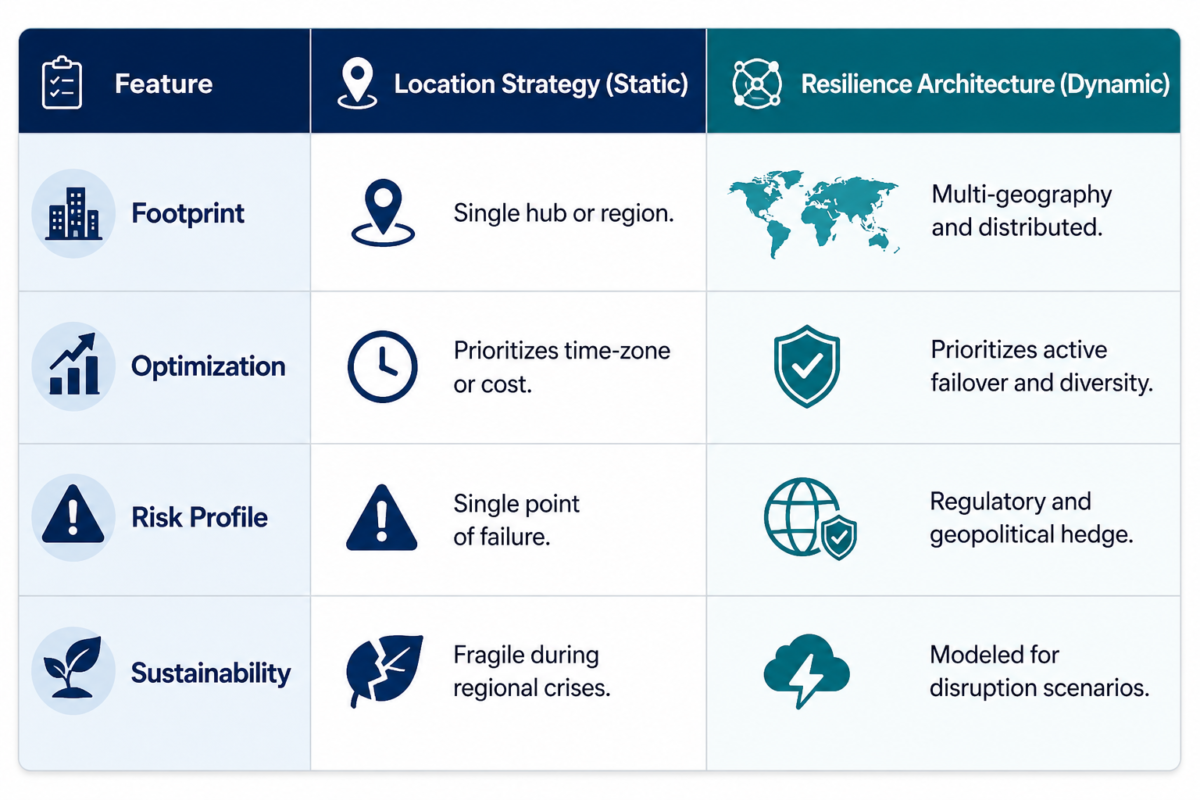
IMAGE:
| Feature | Location Strategy (Static) | Resilience Architecture (Dynamic) |
| Footprint | Single hub or region. | Multi-geography and distributed. |
| Optimization | Prioritizes time-zone or cost. | Prioritizes active failover and diversity. |
| Risk Profile | Single point of failure. | Regulatory and geopolitical hedge. |
| Sustainability | Fragile during regional crises. | Modeled for disruption scenarios. |
The Verdict for 2026
The mistake isn’t going nearshore. The mistake is going nearshore exclusively and mistaking geographic convenience for operational resilience. Those are two different things, and conflating them is exactly the kind of decision that looks smart in the quarterly review and fragile in the crisis debrief.
The leaders who navigate 2026 successfully will be those who refuse to chase trends at the expense of stability. Resilience is built by asking the hard questions today to avoid the crisis debriefs of tomorrow.
The Path Forward
Ultimately, the goal of a robust BPO partnership isn’t just to find a cheaper or closer location, it is to build an operation that is indifferent to volatility. As we move further into 2026, the gap will widen between organizations that are optimized for the “steady state” and those that are architected for reality.
Resilience is not a luxury; it is the baseline for global business. Choosing a partner who prioritizes geographic diversity ensures that your focus remains on growth and innovation, while the operational “what-ifs” are already managed. The most successful strategies won’t be defined by where they started, but by their ability to keep moving regardless of the landscape.
The NCRi Approach: Design by Necessity
At NCRi, our footprint across multiple regions was more of a structural requirement than a branding choice.. By operating across 14 locations and supporting 87+ languages, we ensure that diversity serves as a mechanism for continuity.
When one region faces infrastructural or regulatory pressure, work does not pause; it shifts. This is not a bolt-on feature, but a core design principle that allows us to answer the “what if” questions before they become “what now” emergencies.
Contact NCRi INC today to future-proof your operations with true geographic resilience.
0 comments on “Beyond the Nearshore Hype: Why Geographic Diversity is the Only Real Hedge in 2026”